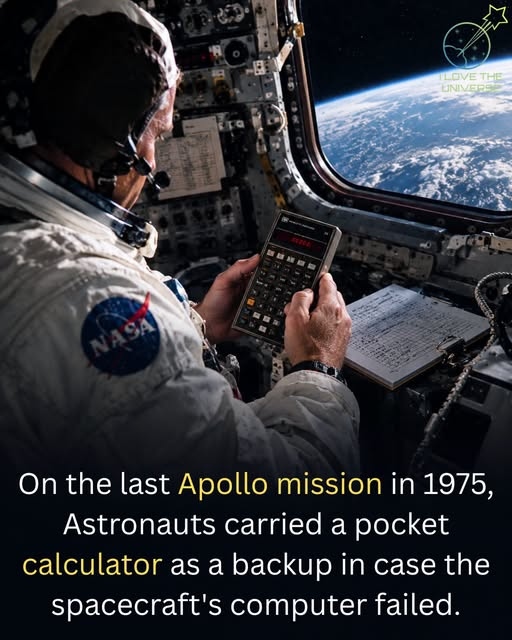
In the 1970s, spacecraft computers were highly specialized machines built specifically for the harsh environment of space. Yet during one historic mission, NASA astronauts carried something surprisingly familiar alongside their sophisticated onboard systems: a handheld calculator.
The calculator was an Hewlett-Packard HP-65, one of the earliest programmable handheld scientific calculators. NASA selected it for the Apollo-Soyuz Test Project (ASTP) in 1975, programming it with rendezvous and guidance equations so it could serve as a backup if the Apollo Guidance Computer became unavailable.
The Last Apollo Mission
The Apollo-Soyuz Test Project launched on July 15, 1975, with three American astronauts—Thomas Stafford, Vance Brand, and Donald “Deke” Slayton—aboard an Apollo spacecraft. A Soviet Soyuz spacecraft launched the same day carrying cosmonauts Alexey Leonov and Valery Kubasov.
Two days later, the two spacecraft successfully docked in orbit, creating the first international human spaceflight partnership between the United States and the Soviet Union. The spacecraft remained together for nearly two days while the crews conducted joint activities and experiments.
The mission was also significant because it was the last flight to use Apollo hardware.
Meet the HP-65
The HP-65 was introduced by Hewlett-Packard in 1974, just one year before Apollo-Soyuz. It was the world’s first magnetic-card programmable handheld scientific calculator.
Unlike an ordinary calculator, the HP-65 could store and run programs using small magnetic cards. That capability made it particularly useful for spaceflight calculations.
NASA programmed the calculator with important rendezvous and guidance equations for the Apollo-Soyuz mission. If the main Apollo Guidance Computer failed, astronauts had another way to perform essential calculations manually.
In other words, a device that could fit in an astronaut’s hand was prepared to serve as a backup to one of the most important computers on the spacecraft.
Why Carry a Calculator Into Space?
Spacecraft systems are designed with redundancy because even a highly reliable computer can potentially fail.
Astronauts also needed ways to perform calculations independently of ground-based computers and onboard systems. NASA’s own historical material notes that Apollo crews used manual calculation methods as part of their backup procedures.
The HP-65 provided something especially valuable: programmability in a tiny package.
Instead of astronauts having to calculate every complicated equation from scratch, the calculator could execute preloaded programs designed for particular calculations.
Surprisingly Powerful for Its Time
The technology may look primitive compared with today’s smartphones, but the HP-65 was remarkably advanced for 1975.
It was small, programmable, and capable of handling scientific calculations. Its magnetic-programming system allowed specialized mathematical routines to be stored and loaded.
NASA’s National Air and Space Museum notes that the HP-65 used on Apollo-Soyuz had been programmed specifically with rendezvous and guidance equations.
This is a fascinating reminder of how quickly computing technology was evolving during the Apollo era.
From Slide Rules to Programmable Calculators
Earlier Apollo missions relied heavily on traditional calculation techniques, including slide rules and other tools.
By the time of Apollo-Soyuz, handheld electronic calculators had begun transforming what astronauts could carry and use in space. The National Air and Space Museum describes the Apollo-Soyuz calculator as a major step in that transition from older calculation tools to compact electronic computing.
The HP-65 therefore represents an important moment in the history of computing: sophisticated mathematical capability was becoming portable.
A Small Device With a Big Role
The story of the HP-65 is more than just an interesting piece of Apollo trivia.
It demonstrates one of the fundamental principles of spaceflight engineering: never depend on a single system when failure could have serious consequences.
The Apollo-Soyuz crew had highly specialized spacecraft computers, ground controllers, procedures, and backup techniques. The little HP-65 added another layer of protection.
Today, a smartphone has vastly more computing power than the electronics available to astronauts in the 1970s. Yet the underlying philosophy remains the same: when humans travel into an environment where help may be far away, reliable backup systems matter.
The humble pocket calculator carried aboard Apollo-Soyuz is therefore a fascinating symbol of the transition from the early computer age to the portable computing revolution.
A calculator that could fit in an astronaut’s hand was prepared to help guide a spacecraft through the vastness of space. 🚀🌎